Brief Introduction of Program
Human nutrition and dietetics are indispensable in the pursuit of public health and individual wellness as they serve as the cornerstones of optimizing human health. These disciplines provide the knowledge and expertise needed to understand the intricate interplay between dietary choices and well-being. Through evidence-based practices, they pay to the prevention and management of a myriad of health conditions, thus reducing the burden on healthcare systems. Furthermore, they empower individuals to make informed dietary decisions, ultimately promoting longevity and an improved quality of life.
Regrettably, the oversight of this critical sector in developing nations such as Pakistan has had detrimental consequences on the health of individuals across all age groups. The potential of nutrition and dietetics in preventing and managing diseases remains vastly untapped, primarily due to the absence of this essential discipline within the country. Recognizing the fundamental importance and extensive scope of these fields, the University of Health Sciences is poised to introduce a four-year degree program, "B.S. (Hons.) Nutrition & Dietetics. This program will provide students with a distinctive and influential career trajectory, enabling them to make substantial contributions to both individual and societal well-being in a continually evolving realm of health and nutrition.

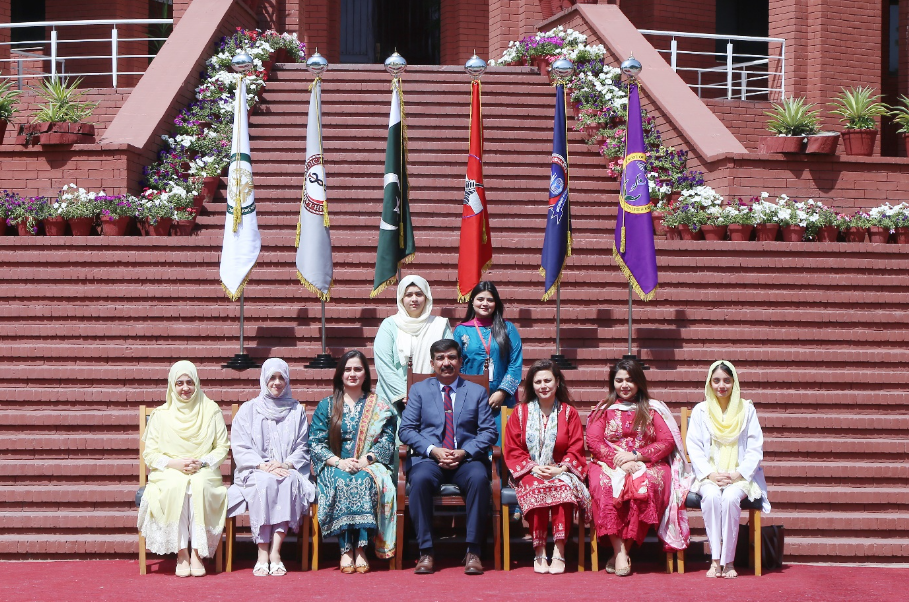
Sitting (L-R): Miss Mahin Jawad, Miss Maham Jawad, Prof Dr Syeda Arooj Fatima, Maj Gen Nadeem Fazal HI (M) (R) Dr Qudsia , Dr Sana Saadat, Miss Zaveera Qutb
Standing (L-R): Miss Sania Saher, Miss Yasha Altaf
The overarching goal of the BS Nutrition and Dietetics program is to empower students with comprehensive professional knowledge, practical skills, advanced techniques, and a strong ethical foundation. This will equip them to function effectively within the healthcare ecosystem, bridging the gap between medical professionals and patients to enhance the efficiency and quality of healthcare service delivery.
The objectives of the BS Nutrition and Dietetics Program are to educate students to attain the following:
Precision and Ethical Proficiency: To Cultivate a commitment to accuracy and meticulousness, promoting high ethical standards and technical excellence.
Skill Evaluation: To Develop the capacity to assess both technical and non-technical competencies within a standardized and reproducible context.
Decision-Making: To Enhance decision-making abilities and the aptitude for sound judgment, particularly in high-pressure situations.
Leadership and Problem-Solving: To Nurture leadership qualities and effective problem- solving and administrative skills, preparing students for leadership roles in healthcare.
Communication Innovation: To Encourage the development and analysis of innovative strategies for effective communication with both patients and healthcare professionals.
Interdisciplinary Collaboration: To Demonstrate the ability to build interdisciplinary teams, facilitating seamless coordination among various Allied Health Disciplines.
Professional Conduct: To Exhibit an understanding of fundamental concepts of professional behavior and grasp the legal implications of their role within the work environment.
Healthcare Role Awareness: To Understand their place and significance within the healthcare delivery system.
Continuing Education: To Establish and sustain a commitment to continuing education as an essential component of professional growth and competence maintenance.
- To prepare competent graduates with scientific knowledge and practical skills in human nutrition and dietetics.
- To promote evidence-based nutritional practices for disease prevention and management.
- To contribute to community health through education, intervention, and research.
- To produce professionals capable of working in hospitals, research institutions, academia, NGOs, and the food industry.
- Degree Title:BS Nutrition
- Duration:4 years (8 semesters)
- Affiliation:University of Health Sciences (UHS), Lahore
- Medium of Instruction:English
- Eligibility: F.Sc (Pre-Medical) or equivalent with minimum 60% marks
- Admission / Selection Process
- Admissions will be made on merit determined according to the marks obtained inMatric & amp; F.Sc. / equivalent exams as per following weightage:-
- Qualification/Test Weightage
- Matric / equivalent = 10%
- F.Sc / equivalent = 40%
- Aptitude Test = 50%
- The admission on local and foreign seats will be conducted on the basis of merit only.
- Admission will be strictly on merit. Any student having incomplete results /academic documents on the closing date for admission application will not beconsidered for admission.
- Admission Committee will supervise the whole admission process.
Graduates of the BSc (Hons) Nutrition program will have diverse career opportunities, including:
- Clinical Nutritionist/Dietitian in hospitals, clinics, and rehabilitation centers.
- Community Nutritionist in NGOs, public health programs, and government initiatives.
- Food & Nutrition Consultant in food industry and quality assurance.
- Academic Career as lecturer or researcher in universities and colleges.
- Health & Wellness Advisor in fitness centers, corporate wellness programs, and media.
- Research Officer in nutrition research projects and international collaborations.
Course Code | Course Title | Theory | Practical | Credit Hours |
GEFE | Functional English | 03 | 00 | 03 |
GEQR | Quantitative Reasoning-I | 03 | 00 | 03 |
GENS | Natural Sciences | 02 | 01 | 03 |
GEAH | Arts and Humanities | 02 | 00 | 02 |
GEICP | Ideology and Constitution of Pakistan | 02 | 00 | 02 |
IDC | Basic Biochemistry | 03 | 00 | 03 |
PERL-I | PERL-I | 01 | 00 | 01 |
Total |
| 16 | 01 | 17 |
Course Code | Course Title | Theory | Practical | Credit Hours |
GEEW | Expository Writing | 03 | 00 | 03 |
GEQR | Quantitative Reasoning-II | 03 | 00 | 03 |
GESS | Social Sciences | 02 | 00 | 02 |
GEIE | Islamic Studies/Ethics | 02 | 00 | 02 |
IDC | Basic Anatomy | 03 | 00 | 03 |
IDC | Basic Physiology | 03 | 00 | 03 |
PERL-II | PERL-II | 01 | 00 | 01 |
Total |
| 17 | 00 | 17 |
Course Code | Course Title | Theory | Practical | Credit Hours |
GEE | Entrepreneurship | 02 | 00 | 02 |
GECCM | Citizenship Education & Community Engagement | 02 | 00 | 02 |
GEICT | Applications of ICT | 02 | 01 | 03 |
IDC | General Pathology | 03 | 00 | 03 |
MFHN | Fundamentals of Human Nutrition | 03 | 00 | 03 |
MFST | Introduction to Food Science & Technology | 02 | 01 | 03 |
EPC-1 | English Proficiency-I | 02 | 00 | 02 |
PERL-III | PERL-III | 01 | 00 | 01 |
Total |
| 17 | 02 | 19 |
Course Code | Course Title | Theory | Practical | Credit Hours |
MMA | Macronutrients in Human Nutrition | 03 | 00 | 03 |
MFM | Food Microbiology | 02 | 01 | 03 |
MMI | Micronutrients in Human Nutrition | 03 | 00 | 03 |
MPNA | Principles of Nutritional Assessment | 02 | 01 | 03 |
MNL | Nutrition through Lifecycle | 03 | 00 | 03 |
MFSM | Fundamentals of Food Service Management | 02 | 01 | 03 |
EPC-2 | English Proficiency-II | 02 | 00 | 02 |
PERL-IV | PERL-IV | 01 | 00 | 01 |
Total |
| 18 | 03 | 21 |
Course Code | Course Title | Theory | Practical | Credit Hours |
MFFN | Functional Foods & Nutraceuticals | 02 | 01 | 03 |
MCN-I | Clinical Nutrition-I | 02 | 01 | 03 |
MHD | Hospital Dietetics | 02 | 01 | 03 |
MNI | Nutritional Immunology | 03 | 00 | 03 |
MNT-I | Medical Nutrition Therapy-I | 02 | 01 | 03 |
MDNI | Drug Nutrient Interaction | 03 | 00 | 03 |
EPC-3 | English Proficiency-III | 02 | 00 | 02 |
PERL-V | PERL-V | 01 | 00 | 01 |
Total |
| 17 | 04 | 21 |
Course Code | Course Title | Theory | Practical | Credit Hours |
EL-1 | Elective I | 03 | 00 | 03 |
MCN-II | Clinical Nutrition-II | 02 | 01 | 03 |
MRMN | Research Methodology in Nutrition | 02 | 01 | 03 |
EL-2 | Elective II | 03 | 00 | 03 |
MNT-II | Medical Nutrition Therapy-II | 02 | 01 | 03 |
MCASN | Clinical Aspects of Sports Nutrition | 03 | 00 | 03 |
EPC-4 | English Proficiency-IV | 02 | 00 | 02 |
PERL-VI | PERL-VI | 01 | 00 | 01 |
Total |
| 18 | 03 | 21 |
Course Code | Course Title | Theory | Practical | Credit Hours |
MFLR | Food Laws & Regulations | 03 | 00 | 03 |
MNPCC | Nutritional Practices in Critical Care | 02 | 01 | 03 |
MBNP | Basics of Nutrigenomics & Proteomics | 02 | 01 | 03 |
MRAND | Recent Advances in Nutrition & Dietetics | 02 | 01 | 03 |
MNCS | Nutritional Counselling Skills | 02 | 01 | 03 |
INT | Internship / Field Experience | 03 | 00 | 03 |
EPC-5 | English Proficiency-V | 02 | 00 | 02 |
PERL-VII | PERL-VII | 01 | 00 | 01 |
Total |
| 17 | 04 | 21 |
Course Code | Course Title | Theory | Practical | Credit Hours |
MPHN | Public Health Nutrition | 03 | 00 | 03 |
MBND | Biotechnology in Nutrition & Dietetics | 02 | 01 | 03 |
MNP | Nutrition & Psychology | 03 | 00 | 03 |
MFTA | Food Toxicology & Additives | 02 | 01 | 03 |
EPC-6 | English Proficiency-VI | 02 | 00 | 02 |
PERL-VIII | PERL-VIII | 01 | 00 | 01 |
CAP | Capstone Project | 00 | 03 | 03 |
Total |
| 13 | 06 | 21 |
The learning outcomes of this program typically include:
- Understanding of Nutrition Science:
Knowledge of macronutrients, micronutrients, digestion, metabolism, and their roles in human health and disease.
- Dietary Assessment and Planning:
Proficiency in assessing individuals’ dietary needs and developing appropriate nutrition plans to promote health and address specific conditions or requirements.
- Food and Nutrition Policy:
Awareness of policies and regulations related to food safety, food labeling, public health, and nutrition guidelines.
- Clinical Nutrition and Therapeutics:
Competence in providing nutritional therapy for various health conditions and diseases, and understanding how nutrition impacts the management and treatment of illnesses.
- Community and Public Health Nutrition:
Knowledge and skills to design and implement nutrition education programs, and promote healthful behaviors in communities and populations.
- Research and Critical Thinking:
Ability to critically evaluate scientific research, design experiments, and contribute to advancements in nutrition science through evidence-based practice.
- Professional Communication and Ethics:
Effective communication skills for interacting with clients, healthcare teams, and the public, while adhering to ethical standards and professional conduct in the field.
- Cultural Competence:
Awareness and understanding of diverse cultural practices and beliefs related to food and nutrition, and the ability to tailor nutrition advice accordingly.
- Lifelong Learning and Professional Development:
Cultivation of a mindset for continuous learning and keeping up-to-date with advancements in nutrition science and related fields.
Upon graduation, our students will showcase their expertise across various domains:
Clinical Dietitians: They will excel in hospitals and private clinics, offering medical nutrition therapy and expert nutritional counseling to patients.
Community Nutritionists: Our graduates will collaborate with national and international organizations, playing a pivotal role in educating and raising awareness about healthy dietary practices in rural areas. Their efforts will contribute to the prevention of nutritional diseases and the promotion of public health.
Nutrition Specialists: They will serve public and private sector organizations, specializing in the field of nutrition supplements to enhance the well-being of individuals.
Nutrition Supervisors: Our alumni will take charge as nutrition supervisors in basic health units across different districts of Punjab, ensuring that communities have access to proper nutritional guidance and support.
Nutrition Officers and Researchers: They will assume roles as nutrition officers and researchers within the health department’s nutrition division, contributing to evidence- based policies and programs aimed at improving public health.
Educators: They will impart their knowledge and expertise as course instructors in education institutions, fostering the next generation of nutrition and dietetics professional
Guidelines – Admission in BS – Human Nutrition and Dietetics
1. BS – HND is affiliated with the National University of Medical Sciences (NUMS).
2. Admissions for BS – HND are expected to be announced in June / July for Fall Session and November / December for Spring Session (whichever is offered).
3. The applicant must have obtained a minimum of 50% marks in F. Sc Pre-Medical / Humanities with Biology & Chemistry Mandatory Subjects / Pre-Agricultural / Pre – Engineering.
4. Applicants are required to qualify NAT (conducted by NTS, valid for 1 year) or USAT (conducted ETC-HEC, valid for 1 year) or NUMS MDCAT (within its validity period of 1 Year) for admission to the desired program.
5. Please visit NTS website for NAT, HEC(ETC) website for USAT and NUMS website for NUMS MDCAT, for details.
6. Admissions will be made strictly on merit according to the following selection criteria:
a. Matric / SSC / Equivalent – 10%
b. F. Sc / HSSC / Equivalent – 40%
c. NUMS MDCAT / NAT / USAT – 50%
7. The admission timeline will be announced on our official website accordingly.
8. For any queries, please contact at phone number +92-42-36605550-51, extn: 412 or email at: registration@cmhlahore.edu.pk
Nutrition Faculty Profile

Dr. Sana Saadat
HOD & Assistant Professor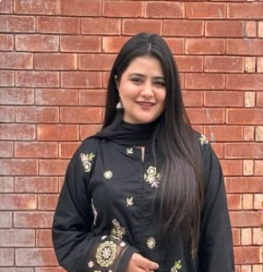
Ms. Yasha Altaf
Demonstrator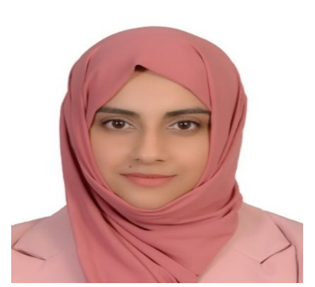
Dr Maham Jawad
Chief Dietitian / Critical Care Nutritionist
Ms. Zaveera Qutb
Dietitian / Clinical Nutritionist
Ms. Fajer Ayub
Dietitian / Clinical Nutritionist